E-Waste to Eco-Art: Circuit Boards and Computer Parts Reborn
- violanng
- Feb 20
- 2 min read

Every day, 142,000 computers are discarded in the United States alone—yet these technological relics harbor hidden beauty. Artists worldwide are rescuing circuit boards, keyboard keys, hard drives, and cables from landfills, transforming them into sustainable art materials that challenge our throwaway culture while championing eco-conscious living.
The global e-waste crisis is staggering: 53.6 million metric tons generated in 2019, with projections reaching 74 million tons by 2030. Only 17% gets properly recycled, leaving billions in recoverable materials—and extraordinary artistic potential—buried in landfills. Enter the e-waste artists turning digital debris into museum-worthy circular design art.


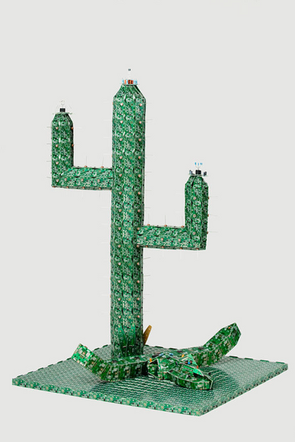
Steven Rodrig (Cuba-born, New Jersey-based) pioneered circuit board sculpture through his "PCB Creations," transforming green boards with colorful components into animals, landscapes, and even a life-size "Royal Data Throne" toilet. His pieces—ranging from hummingbirds to sea turtles with titles like "Sea Turtle Searches for Deep Data"—showcase transistors, resistors, and capacitors as organic forms. Featured in Manhattan Arts International's permanent collection, Rodrig's work proves e-waste is "just lack of imagination."


Laura Moore creates mosaic masterpieces that depict cell phone circuit boards, but uses an ingenious reversal: she sources leftover stone tiles—particularly marble and limestone—from home renovation projects via Facebook Marketplace, then meticulously arranges them to recreate the visual patterns of circuit boards. Her exhibition "We Were Here" at Toronto's Zalucky Contemporary features five wall-mounted mosaics picturing circuit boards alongside vintage electronics—Macintosh computers, Sony boomboxes, cassette recorders—entombed in stone tiles. This "speculative archeology" treats our technological artifacts as ancient relics, imagining what future archaeologists might discover about our digital age.


Keyboard keys fuel another creative revolution. Artists craft geek-chic jewelry—bracelets, earrings, necklaces—from discarded keys, while ChipScapes transforms silicon wafers and computer chips into wearable art that merges steampunk and art deco aesthetics.


Amanda Preske's "Because Science" turns circuit boards into pendants and wall art, sparking conversations about responsible recycling.

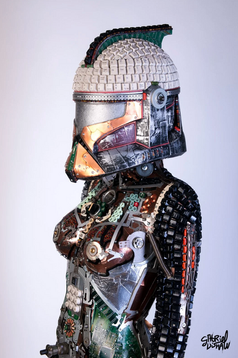


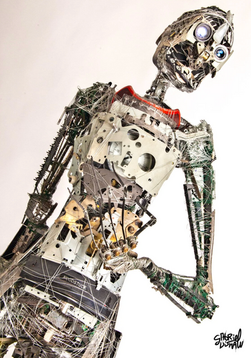


Indianapolis-based artist Gabriel Dishaw has elevated e-waste sculpture to gallery-level artistry over his 25-year career. Dishaw disassembles vintage adding machines, typewriters, computer keyboards, circuit boards, and Apple Mac components—materials that would typically end landfills—then meticulously reimagines them into pop culture icons. His "Mac Vader" series transforms Apple computer parts into Darth Vader helmets, while commissioned works for corporations like VIZIO and Capital One demonstrate how e-waste can become corporate art. Beyond electronics, Dishaw also deconstructs luxury goods like vintage Louis Vuitton and Gucci, creating hybrid sculptures (like Louis Vuitton-embellished Stormtroopers and Pokémon) that challenge conversations around consumption, waste, and value. His mission: inspire dialogue on reducing waste through creative, environmentally sound repurposing.
These e-waste artists are rewriting the narrative around obsolescence. What was once destined for landfills—circuit boards, hard drives, typewriter keys—now hangs in galleries and private collections as powerful upcycled art for sale. Their work proves that sustainable art materials aren't a compromise but an opportunity, transforming digital debris into conversation-starting circular design art that belongs in any eco-conscious living space. One rescued motherboard at a time, they're building a more beautiful, sustainable future.


Comments